
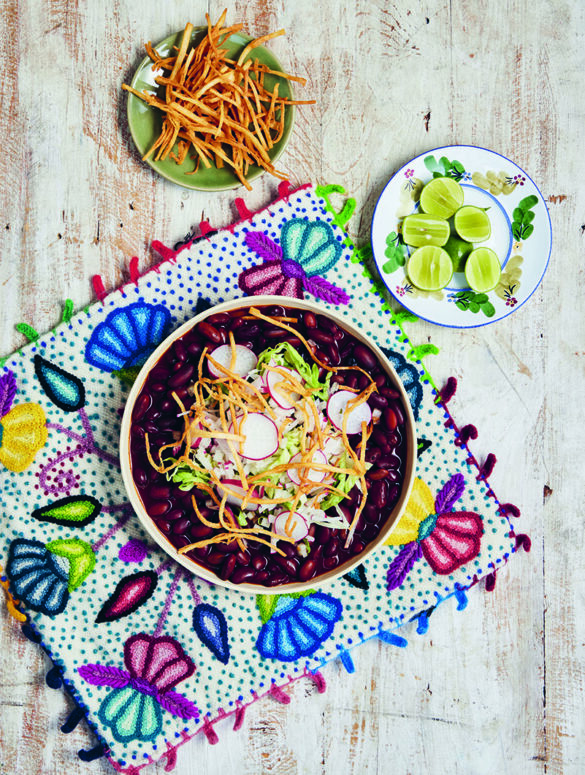
While vegetarian versions exist, traditional preparations of pozole rojo, especially in the state of Jalisco, include pork bones in some form to give the stew its rich texture and flavour. We use pork ribs, though bones from the head, neck, shank, or even feet are commonly used.
Serves: 6
Preparation Time: 15 minutes, plus 25 minutes soaking
Cook Time: 3 hours 45 minutes
Ingredients
- 900g pork shoulder, diced
- 450g pork ribs, cut into pieces
- 1½ white onions, quartered
- 12 garlic cloves, peeled
- 4 litres water
- 5 ancho chiles, seeded and veins removed
- 5 guajillo chiles, seeded and veins removed
- ½ teaspoon Mexican oregano
- 2 tablespoons vegetable oil
- 6 cups/1.4 litres canned hominy, rinsed and drained (or 2 cups/475ml) dried hominy, soaked for at least 6 hours)
- salt and ground pepper
To serve
- sliced radishes sliced
- white onion
- lettuce leaves
- lime wedges
Method
Place the pork shoulder, pork ribs, 1 onion, 6 garlic cloves, and some salt in a large pan. Pour over the measured water, bring to a boil, then lower the heat. Cook for about 2 hours 30 minutes, or until the meat comes off the bone. Remove the surface layer of foam and grease that forms on the broth as it cooks. If necessary, add more hot water to keep the level of broth in the pot. Remove the cooked meat and set aside, reserving the stock.
To prepare the sauce, soak all the chilli in enough water to cover for 25 minutes. Once soft, drain and place in a blender, with the remaining garlic, onion, and the oregano. Add a little of the stock to blend until smooth.
Heat the oil in a small pan over medium-high heat, then add the sauce, and season with salt. Reduce the heat and simmer for about 25 minutes, then strain and mix in with the reserved cooking stock. Bring to a boil, then add the meat and lower the heat, letting it simmer for 10 minutes. Add the hominy and season with salt and pepper. Continue cooking until the hominy is completely cooked, about 40 minutes.
Serve warm in a deep dish and garnished with radish, onion, lettuce, and lime wedges.
Extracted from The Latin American Cookbook by Virgilio Martínez | Published by Phaidon.
Available 15 October | phaidon.com