
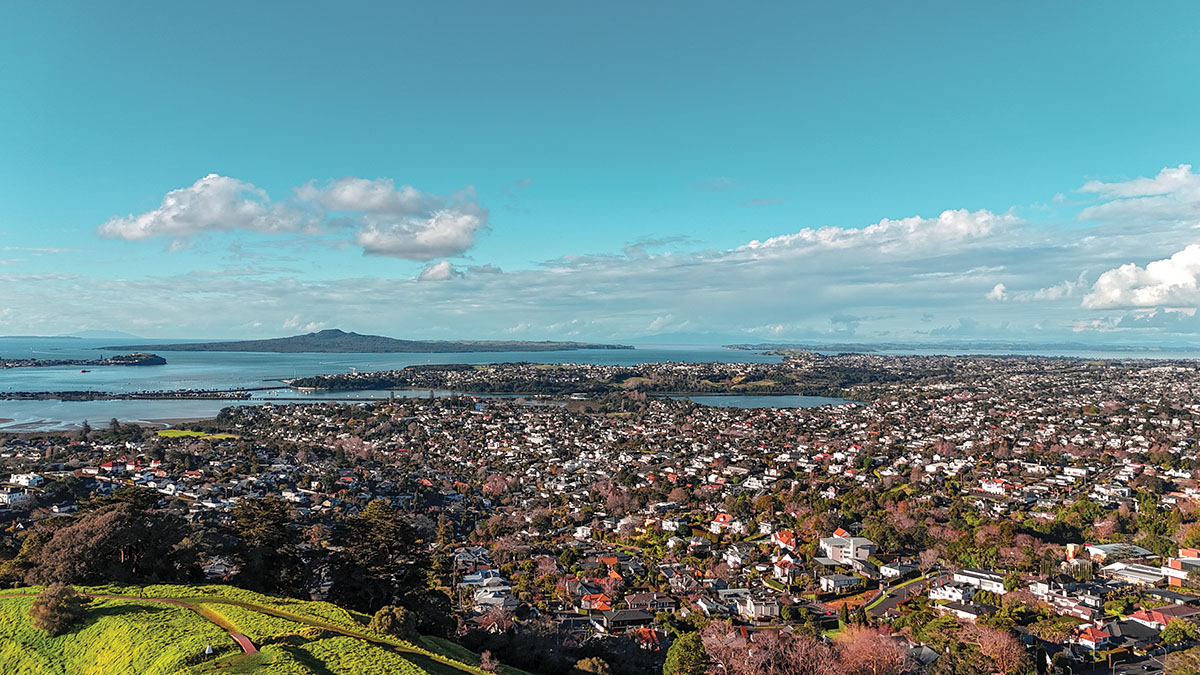
Leafy Remuera sits in the shadow of Ōhinerau Mount Hobson and is famed for its Edwardian and mid-century homes, abundance of green spaces, and sweeping views of Waitematā Harbour and Rangitoto.
REMUERA RISING
The suburb sits in the centre of our isthmus, with its name believed to derive from the two words: ‘remu’, meaning edge or hem; and ‘wera’, meaning burnt. It’s thought to refer to an incident in which a visiting chieftainess was killed and placed in an umu (earth oven) while still wearing her piupiu (skirt). Remuwera was originally the moniker given to an area of Ōhinerau Mount Hobson, a former pā.
EARLY RISERS
Remuera’s early European landowners transformed much of the land into orchards, gardens, and paddocks, and built stately two-storey homes. One prominent resident, Archibald Clark, became Auckland’s first mayor in 1851. Remuera Road began as a muddy cart track to Tāmaki, lined in time with shops such as L. J. Keys’ grocery – the suburb’s first store – which was later joined by a bootmaker, chemist, dairy, and more. Horse-drawn trams once looped at Temperance Terrace (now St Vincent Ave) before electrification in 1904, while the Tudor Theatre, opened in 1928, became a lively social hub.
ROARING REMUERA
Brothers William and George Henning of Ōhinerau Street were pioneers of New Zealand’s motor industry. In 1895 they made history by importing Auckland’s first motorised vehicle – a three-wheeled tricycle from Europe. William later served in the first world war, where he was awarded the Military Cross for conspicuous gallantry and resourcefulness, before tragically dying of wounds in France in 1918, aged just 33. By the 1920s, their trailblazing efforts had helped pave the way for a new sight on Remuera’s streets: automobiles steadily replacing horse-drawn carts.
IN GOOD SPIRIT
Long before Orakei Bay Village bustled with cafes and shops, the site was home to one of New Zealand’s most significant gin distilleries. Opened in 1959, the New Zealand Distillery Company began by bottling imported spirits from England, before switching to locally produced alcohol from Edgecumbe, Bay of Plenty. Up to 100 staff worked there, managed by the stern Scotsman Grainger Hannah. The plant became a powerhouse, with millions in customs duty flowing back to the government each year. But in 1992 the stills fell silent: Guinness, now owner of Gordon’s Gin, shut the doors after duty protections ended. The equipment was dismantled and shipped back to England – an era ended.
RMS REMUERA
Launched in 1911, the RMS Remuera was a grand passenger-cargo liner built along the Clyde in Scotland. Named after Auckland’s prestigious suburb, she served the London–Wellington route and, in 1916, became the first NZ Shipping Co. vessel to transit the newly opened Panama Canal. During the first world war, she was requisitioned as a troop ship; after the war she returned to peacetime travel and notably, carried the All Blacks on their landmark 1924 British tour, as well as the 1928 NZ Olympic team. She was called upon again during the second world war and, on 26 August 1940, was torpedoed in the North Sea and tragically sank – but all 93 crew and a gunner survived.
REMUERA RAMBLES
Remuera remains a leafy playground ideal for families, dog walkers, and nature lovers alike. Little Rangitoto Reserve surprises visitors with its volcanic origins and modern offerings like a flying fox, skate bowl, climbing frames, and a scooter-friendly loop. Waiatarua Reserve, Auckland’s largest urban wetland restoration, welcomes joggers and birdwatchers to wander through native plantings, playgrounds, and has a skate park, too. And, for sweeping views and a rewarding climb, Ōhinerau Mount Hobson rises with terraced slopes, war memorials, and panoramic vistas of the city and Waitematā Harbour.