
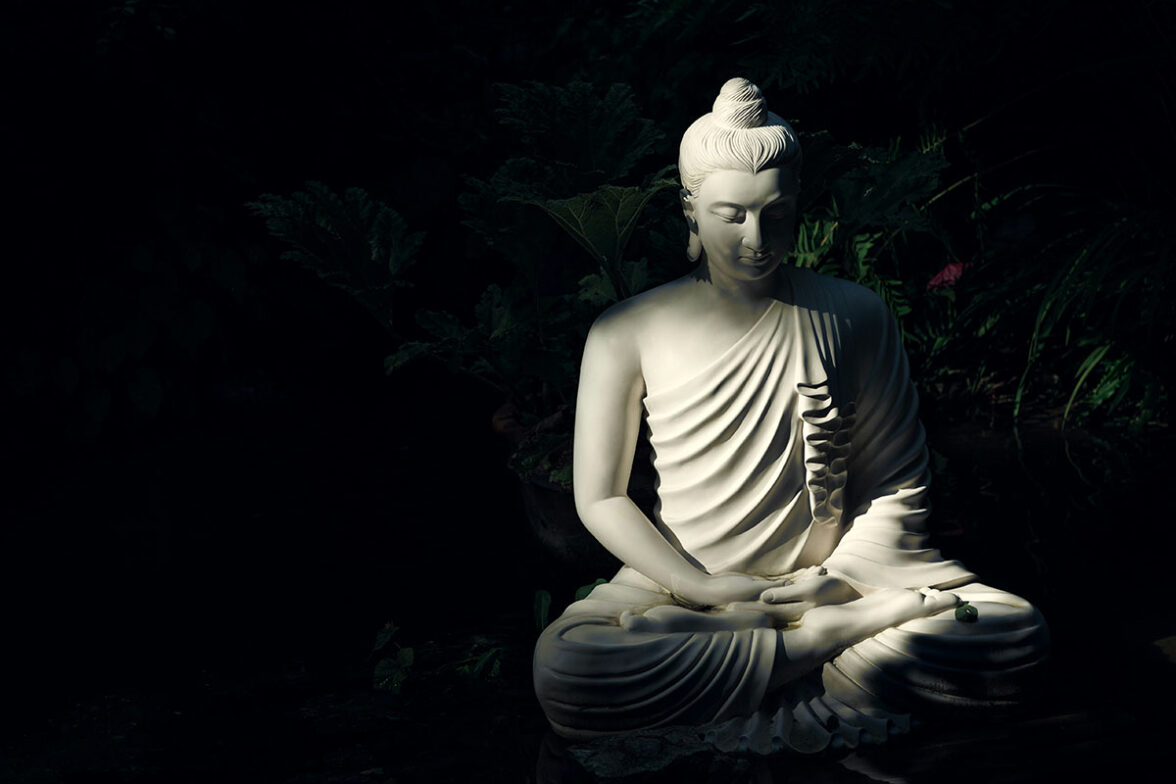
2,500 years ago in ancient India, a man was born who would change the way people thought about life and suffering forever.
His name was Siddhartha Gautama, though by the time he died he would be known as the Buddha, a ‘fully awakened one’. At the age of 35 he gained enlightenment and underwent a profound shift in his relationship to the world. He spent the next 55 years sharing what he had discovered: the unbecoming of the self-interested self and the pathway to end all suffering. India, the birthplace of Buddhism, remains steeped in spiritual history, sustained by generations devoted to inner freedom. Contemplating this can invite a few inquisitive questions: What would enlightenment be like today? Is it applicable to the modern world? What would it feel like to be enlightened? How would it change you?
Two of the most central qualities of enlightenment are the faculties of infinite compassion and infinite wisdom. What do these mean? Imagine your most compassionate self, the most loving, understanding, and accepting person you have ever been, overflowing with boundless, unconditional care. Now imagine that state is utterly immovable. No matter what happens, no matter how someone attempts to divide and break you, all you find within is an unshakable love and understanding. This is infinite compassion, a quality of a Buddha.
Two of the most central qualities of enlightenment are the faculties of infinite compassion and infinite wisdom.
What about infinite wisdom? Imagine looking inside yourself and seeing with absolute certainty the reasons for the way things are. Second-guessing no longer exists, confusion and delusion are gone forever. You bring light to the concerns of others with penetrating clarity – with insight and vision that sees beneath the surface. The true nature of reality, in all its beauty and wonder, is at your fingertips. This is infinite wisdom, another characteristic of a Buddha.
With the rise of mis- and disinformation, hate and division, the world needs us, as individuals, to look inside and find the sparks of buddhahood. We should understand that compassion and wisdom are creative forces that bring people together to transcend the illusion of self-interest – the root of division. Choosing to meet the world with compassion and wisdom is itself an act of self and communal love and liberation. This is exactly what the Buddha and the mystics of ancient India stood for.
Fletcher Sunde is a certified meditation teacher; learn more at meditatewithfletch.co.nz
WORDS — FLETCHER SUNDE