
Words —
Denise Stephens
The Nakasendo Road winds through centuries-old villages and forests in the Japanese Alps.
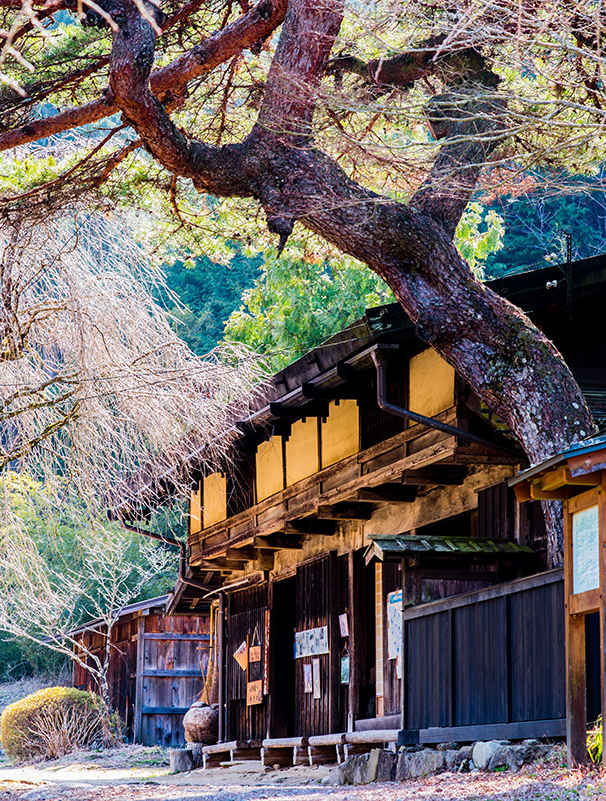
Traditional dark wooden buildings line the paved street with no power lines or cars in sight, reminiscent of another age. I’m in Magome, a preserved post town that is the starting point for one of the most popular walks along Japan’s Nakasendo Road.
Nakasendo means central mountain route, and in Edo era Japan it was one of two roads between Tokyo and Kyoto. Feudal lords travelled along it to visit the emperor’s court in Kyoto, passing through 69 post towns along the way that provided lodging and food.
Magome is still providing lodging and food today. A short uphill walk brings me to Hillbilly Coffee Roasters, and after sipping a silky-smooth cappuccino, I head off through the town.
Souvenir shops are just opening. Water races through channels at the side of the road, feeding into water wheels and bamboo pipes to irrigate gardens.
I pass the honjin where lords and high-ranking travellers stayed in centuries past. It’s now a museum dedicated to Toson Shimazaki, one of Japan’s literary giants. A little further is the waki-honjin, Magome’s local museum.
The path levels out at an observation point looking over the Kiso Valley, where I look back at Magome, and the hills folding into the distance. Out here in the countryside locals tend fields of vegetables and rice, with clumps of purple, yellow and white irises growing wild around the edges.
I walk into the forest, where the air is scented with cryptomeria, the Japanese cedar. Its cool shade is a welcome relief after the uphill walk. Stone monuments rest among the trees, their inscriptions illegible after years of weathering by the elements. In the background are sounds of birdsong and water flowing in a stream somewhere out of sight.
Bears inhabit this area, so bells are placed along the trail to warn them off. When I arrive at the first bell, I ring it loudly, but I don’t feel unsafe. There are other walkers making enough noise with their chatter and footsteps to keep any bears away.
Two kilometres into the walk, I reach the Magome Pass, the highest point on this section of the Nakasendo. Across the main road a soba noodle shop is open for hungry walkers, but I walk past it to go downhill for the remaining 5km to Tsumago. Here and there the trail passes a farm or shrine, or goes through a sleepy hamlet with a few old houses. After walking for nearly two hours, I spot a rustic building in the middle of nowhere that seems to buzz with activity.
Tateba Chaya is a tea house that is over 200 years old. I step inside to find tables arranged on an earth floor. On the raised wood floor at the other side of the room, an elderly gentleman is boiling water in a kettle suspended over a smoky open fireplace. He’s one of the volunteers who welcome visitors and provide tea in return for donations to help preserve the tea house. I find a seat at a table where I chat with walkers from Canada and the United Kingdom over a cup of green tea. After resting my legs for a while, I’m ready to move on.
A quick detour off the main trail leads to the Otaki and Metaki waterfalls. Although they’re small, it’s refreshing sitting by the rushing water as the day warms up. Back on the trail, the signposts show that Tsumago is getting closer, and now I’m beginning to feel hungry.
The town finally comes into view, across the main road and down the hill. Like Magome, the street is lined with traditional black wooden buildings, but fortunately it’s flatter. I wander past Tsumago’s honjin and waki-honjin, looking for somewhere to eat. My first stop is for a chestnut ice cream to cool down while I check out the local restaurants. Soba is a local specialty and just what I need after a long walk, so I enter one of the old houses where I’m served a steaming bowl of noodles.
Although my legs are starting to ache, walking the Nakasendo Road has taken me through a slice of traditional Japan. I decide to end the day by soaking in an onsen, just as travellers in feudal times did.