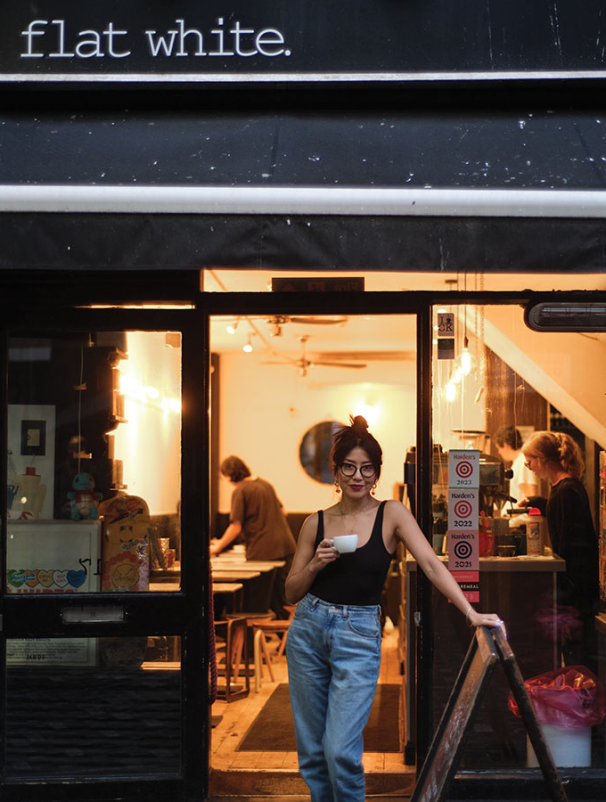
Born in Dunedin and now based between London and Lisbon, Celeste Wong – better known as The Girl in the Cafe – has built an international reputation as a barista, author, judge and coffee storyteller.
Named one of London’s top five baristas by the Financial Times, she has taken her passion for the perfect cup from behind the café counter to the global stage.
Her fascination with coffee was sparked by “the taste and the culture, and the feeling of being connected to this whole expanding world I hadn’t known was there,” she tells Verve.
“What pulled me in wasn’t just chasing the perfect cup so much as realising coffee was a doorway. Every bean had a place, a person and a story behind it, and the more I learned the bigger the world got, not smaller. That’s what hooked me, and honestly it still does.”
What does it actually take to make an exceptional coffee – science, artistry, intuition, or a combination?
All three. But one is missing. The skill is knowing when to lean on which. There’s real science underneath it, ratios, extraction, grind, temperature, and you can’t fake that part. But once the fundamentals are solid, the artistry and intuition are what make a coffee feel like something rather than just taste technically correct. The best coffee people I know hold the technical knowledge lightly. After a lot of practice and experience, they know the rules well enough to stop thinking about them. But the missing ingredient which makes an exceptional coffee is passion.
Your book, Coffee Creations, encourages people to experiment with coffee at home. What do people often get wrong?
Two opposite mistakes, funnily enough. Some overcomplicate it, chasing gadgets and gimmicks when the basics would serve them far better. Others under-invest in the things that genuinely matter: fresh specialty beans, a decent grinder, and a set of scales. Grinding well and actually weighing your coffee will do more for your cup than almost anything else. Great coffee at home isn’t about being fancy, it’s about being consistent.
Why do you think coffee holds such a special place in our everyday lives?
Because it’s rarely only about the coffee. It’s the pause, the ritual, the excuse to sit with someone, or with yourself, for 10 minutes. In a day that asks a lot of us, it’s one of the few small things that stays entirely yours. Everyone is cutting things out at the moment, but coffee is the one thing I’d tell them to keep. It’s linked to more health benefits than almost anything else you could drink, and even good decaf counts. It tastes incredible, and it’s good for you. What’s not to love? Plus, it connects people. It’s a beautiful thing to watch. That’s the part I never tire of.
Does New Zealand’s coffee culture deserve more recognition internationally?
Yes, though I’d say it’s already quietly earnt it, whether or not it gets credited. New Zealand punches well above its size. The expectation that even a small-town cafe will do a decent coffee isn’t normal globally, and I don’t think Kiwis always realise how spoiled they are. Having travelled a lot, I’ve become very aware of how bad service and hospitality can be elsewhere. New Zealanders are good at it without seeming to try, which is the hardest version to pull off.
What New Zealand did brilliantly – along with Australia – was cement a strong coffee culture ahead of the curve, recognise its importance, and take pride in it as a craft. That passion travelled. It drove real change overseas, certainly in the UK, where I lived through the early third wave years that arrived well after Australia and New Zealand had done the groundwork. The flat white is the obvious example. Most of the world had never heard of one until we brought it there, and now it’s on every menu going.
But information moves fast now. People travel, they research, they share everything, and other parts of the world have not only caught up but in some areas gone further, particularly in brewing technique, green sourcing and roasting. Espresso started in Italy. New Zealand took the method and built a culture of its own around it. Now others are taking that method, along with some of our coffee culture, and building something of their own again.
A coffee standing at a bar in Rome is still unbeatable and it has nothing to do with extraction. It’s an experience rather than a standard, and what New Zealand built is a standard you can live with every day. Both are worth having.
What’s your favourite coffee memory?
Two, and they’re very different. The first is my gateway drink.
I write about it properly in the book, so I won’t give it away here. But it was a bohemian little place in Dunedin, bands playing, very late at night, and I was out with my older siblings and their friends. I was far too young to be awake, far too young to be in that venue, and certainly far too young to be drinking coffee at all. That was most of the appeal. I felt grown up and slightly naughty, and I’ve never quite lost the association between coffee and being let into a bigger world.
The second is where I actually learnt to make it. The Strictly Coffee Company, a wonderfully retro place in Dunedin, busier than anything I can imagine now. Every day at 2pm we’d sit down under this enormous vintage photograph of Queenstown, the original founding owners, my first coffee mentor and me, and I’d make everyone traditional cappuccinos and be judged on them. I was the newbie, so it was a daily test. It was also the best training I ever had, and the place that ignited my passion for coffee.
After so many years immersed in coffee, what still excites you about the industry, and what’s next?
What still excites me is that coffee keeps opening up. We’re heading into a genuinely experimental era and the ceiling keeps lifting. And the connection never gets old. It’s the one constant across every version of my career.
As for what’s next, a few things at once. Some cafe consulting, ongoing work with individuals and brands I believe in, and something more personal I’m writing. I’d love to get my web series and podcast going again, and I’m always open to the right people to make that happen. I’m also auditioning for film and television, which has always run alongside the coffee and which I’d like to give more room. I split my time between London and Lisbon, and in June 2027 World of Coffee comes to Lisbon for the first time ever, which feels like the two halves of my life meeting in one place. I fully intend to be involved somehow.
And I’ll always come back to New Zealand for the right project, coffee or acting. I’ve been lucky enough to be back for some film work recently, which was a joy. Any excuse, really. My family and my best friend have long since worked out that a work trip means I stay much longer than I need to, and none of us are complaining.
Celeste’s book, Coffee Creations, is available at Time Out Bookstore and The Urban Studio in Auckland, and in Dunedin at University Book Shop, Otago, or order it online. Find out more at thegirlinthecafe.co.uk